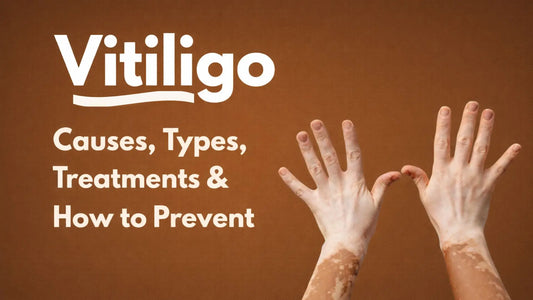
Vitiligo Explained: Causes, Types, Treatments & How to Prevent It from Spreading
Vitiligo is not just a skin problem; it affects the confidence of people affected by it. This skin condition can be genetic or due to other factors as well. There are various treatment options available that can be your support in this healing journey.
Read this blog if you want to know more about vitiligo, why it occurs and discover ways to prevent it from spreading.
Understanding Vitiligo and Its Types
Vitiligo is also recognised as safed daag in India. It is an autoimmune disorder, mainly a skin condition where the skin colour becomes uneven and white patches spread all over the body. A person with vitiligo starts losing their original skin colour as the body’s immune system starts attacking melanocytes, cells responsible for the body’s pigmentation.
A person with vitiligo usually starts getting its symptoms in childhood or early adulthood; In many cases it progresses actively for a few years and then becomes stable, though in some people it can remain active lifelong. It can affect any part of the body and sometimes more than half the body surface. It commonly appears on the face, lips, hands, arms, feet, and around body openings.
Types of Vitiligo
There are different types of vitiligo; let’s discuss some of the key ones that people are usually affected by.
1. Non segmental Vitiligo
In this vitiligo condition, symmetrical white patches appear on both sides of the body, often in areas like the hands, face, and around body openings.
2. Segmental Vitiligo
Presents as patches usually limited to one part or segment of the body, often with a rapid onset and stabilization within one or two years
Apart from these major types, there are other types as well as such as Mucosal, Acrofacial, Focal and Universal Vitiligo.
Causes of Vitiligo
The condition of vitiligo occurs when the colour-giving cells of the skin, melanocytes, are destroyed. Now there are various genetic, autoimmune, environmental, and biochemical factors responsible for this destruction.
Here are the major causes of vitiligo-
1. Autoimmune condition
Vitiligo can be a result of an autoimmune condition where the immune cells start destroying melanocytes, cells that give the body colour.
2. Genetic Reasons
People with a family history of vitiligo or any other autoimmune disorder, such as Addison’s disease, Pernicious anemia, or Psoriasis, etc, are more likely to develop this skin condition.
3. Environmental factors
Vitiligo can also occur as a result of serious skin conditions, cuts, burns, sunburn. Mostly occurs in those who are easily vulnerable to such skin conditions.
4. Oxidative Stress
It arises due to the release of natural chemicals by melanocytes. However, too much oxidative stress can damage these cells and lead to white patches all over the skin.
5. Neurochemical factors
Vitiligo can also happen or get triggered when a person’s nerves release a chemical that accidentally harms nearby pigment cells, causing colour loss in specific skin areas.
Vitiligo Treatment Options: Therapy, Surgery and Ayurvedic Treatment
Vitiligo treatment is based on two major goals: first is to stop the arrest of further depigmentation, and second is to induce repigmentation. It can be achieved through the following treatment options-
1. Depigmentation Therapy
This therapy is done when repigmentation is not possible. So, the remaining pigment is evened out to match the changed skin colour with creams.
2. Surgery
Many vitiligo patients also opt for treatments such as melanocyte transplants, skin grafting, and cell suspension transplantation for stable vitiligo patches. It is directed towards stopping the progression of the disease and achieving repigmentation.
3. Phototherapy
It’s the therapy that uses narrow-band ultraviolet B to stop or slow the progression of vitiligo. Taking it two to three times a week is usually considered good for your skin. However, it’s best to perform it under medical supervision only.
4. Non-cultured epidermal cell suspension (NCES)
In this treatment, the donor, i.e the person with healthy skin, covers a large area of the recipient’s skin, the person affected with vitiligo. This procedure is carried out to avoid postoperative pain and discomfort, easier placement of cellular graft, and excellent colour match.
5. Ayurvedic Treatment
Ayurveda emphasises the importance of herbs in treating vitiligo. Saumya Plus, an Ayurvedic formulation, contains herbs such as Babchi, Triphala, and Aloe vera.
Together, these herbs work towards boosting melanin, nourishing skin, and promoting even pigmentation. The best part about this treatment is that it’s all natural, with no known side effects.
Stop Vitiligo from Spreading: Precautions to Take!
It’s said that prevention is better than cure. To prevent pain, irritation and skin health during vitiligo, it’s important to be mindful of certain things.
- Protect your skin against the sun, and make sure not to expose yourself to intense heat.
- Try to avoid skin cuts, scrapes, burns, and tattoos.
- Have a balanced, nutrient-rich diet and avoid foods that are excessively salty, sour, or acidic.
- Practice stress-relieving techniques to manage your stress.
- Avoid foods that are excessively salty, sour, or acidic.
Conclusion
Vitiligo is an incurable yet manageable condition. Ayurveda emphasises the importance of self-management through internal healing and balance. Be mindful of your diet and skin care routine. Try to avoid being around excessive sunlight and regularly visit your dermatologist to monitor your progress. For more such detailed guides regarding health issues, consider visiting our blog.
FAQs
1. Can vitiligo be cured in early stages?
There is no definite evidence about its cure. However, early treatment during such circumstances can prevent further pigment loss and stop its progression.
2. What causes vitiligo to spread?
There are different reasons why vitiligo spreads. It usually differs from person to person. But the major reasons are excessive oxidative stress, environmental triggers, and autoimmune reactions.
3. What are the major causes of vitiligo in adults?
The major reasons why vitiligo occurs in adults are autoimmune destruction of pigment cells called melanocytes, genetic susceptibility, and due to triggers like skin injury, sunburn, emotional stress, or chemical exposures.
4. What is the best Ayurvedic treatment for vitiligo in India?
The best Ayurvedic treatment for vitiligo involves a combination of lifestyle changes and the right medicine. Saumya Plus is one such medicine infused with such herbs that heal vitiligo-related pain and skin issues from the roots.
5. What are the early signs of vitiligo on the face?
Vitiligo on face can be identified as small, pale or white patches of skin, most often around the eyes, mouth or nose. These patches are usually painless and have smooth or irregular edges.

SAT KARTAR
Sat Kartar Limited is a trusted name in the field of Ayurveda, dedicated towards bringing you a holistic solution for your overall wellness. We have been serving people with real, natural solutions for more than 12 years. Through our educational blogs, health resources, and product innovations, we aim to empower people to embrace Ayurveda as a way of life and restore their inner balance, strength, and vitality.